
Summit
Kids ages 12+
What is Summit?
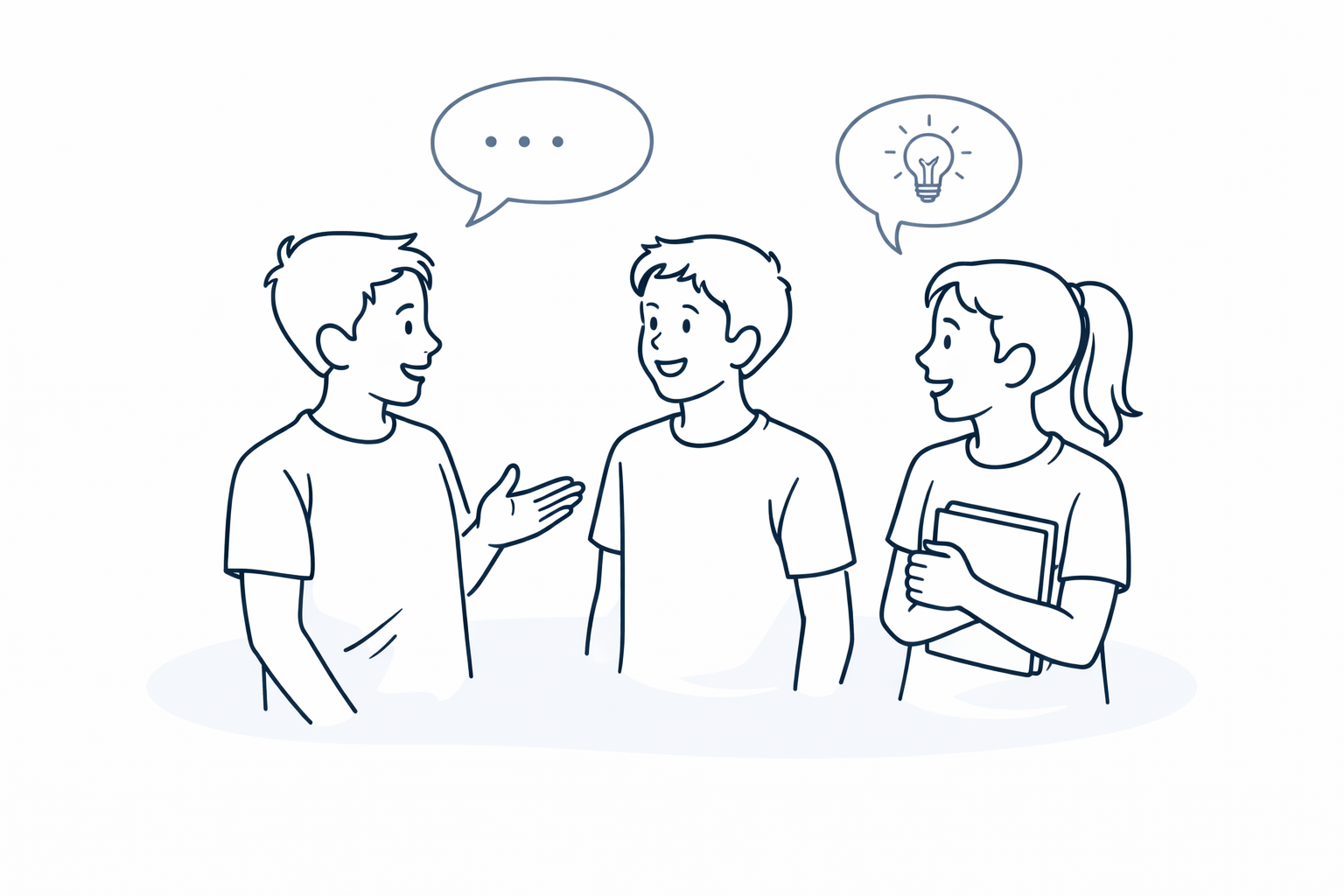
Summit is PTW's upper program for students in 7th, 8th, and 9th grade. It picks up where the grammar years leave off — moving students from absorbing knowledge to working with it. Where Approach and Base Camp built the foundation, Summit is where students begin to think analytically, argue from evidence, engage ideas across disciplines, and connect their faith to what they are learning.
The program runs as a full day on Tuesdays alongside the rest of the co-op community, and is structured around six strands taught by a team of leads — each teaching from genuine strength in their subject. Summit is not a separate track. It is the next step in the same community students have grown up in.
Seventh Grade
Summit A
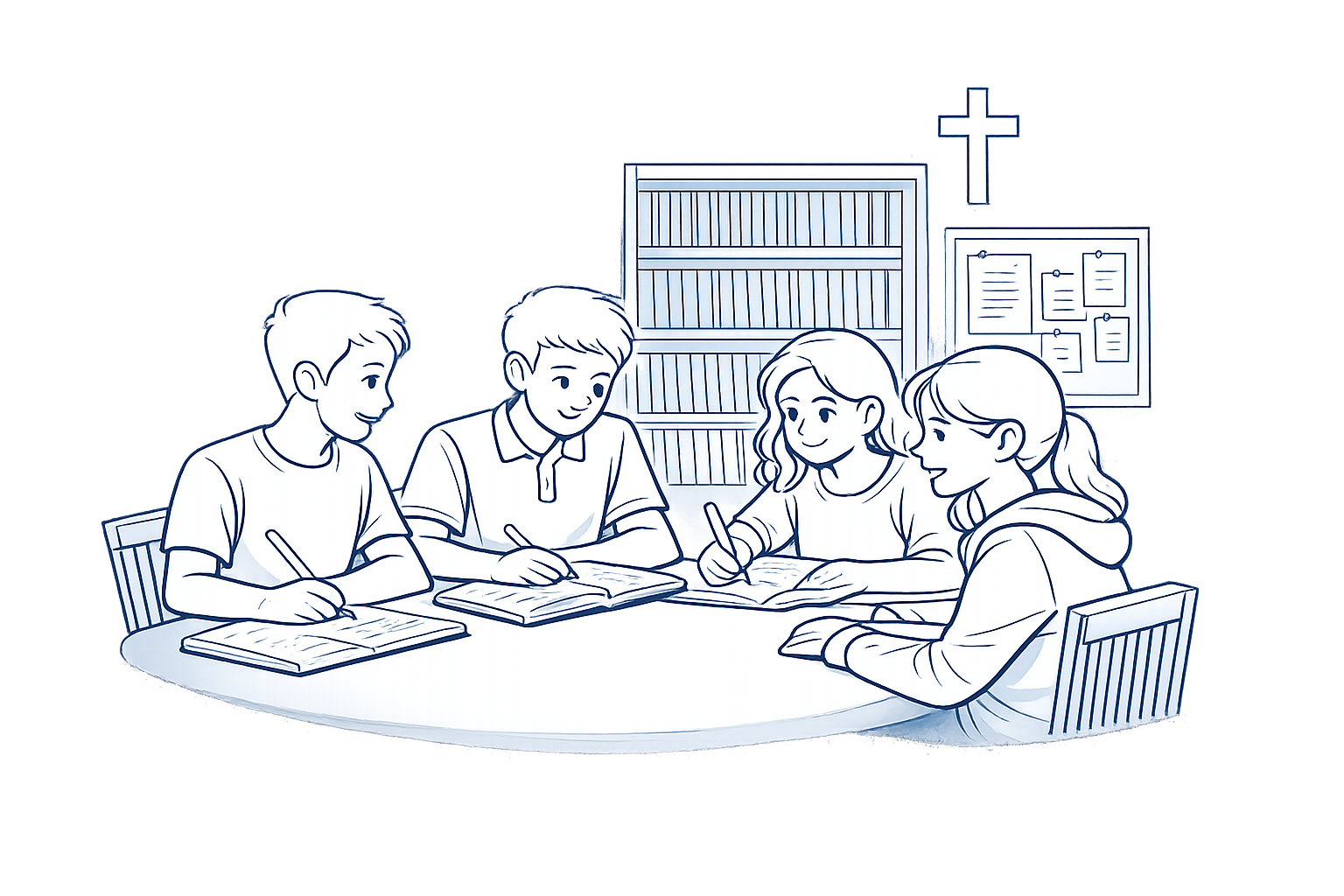
Summit A is the first year of PTW's upper program, designed for students entering 7th grade. Where the grammar years built a foundation of knowledge — memory work, facts, timelines, and vocabulary — Summit A begins the shift toward understanding why things are true and how to think about them. Students move from receiving information to analyzing it, questioning it, and learning to defend what they believe.
Six strands, multiple leads: Summit A is structured around Latin, geography, logic, research, philosophy, and persuasive writing — each taught by a lead who brings genuine preparation and expertise to that subject. Students benefit from depth and engagement every week.
Biblical worldview as the lens: Every subject — logic, history, literature, science — is taught with Scripture as the interpretive framework. Students are not just learning to think clearly; they are learning to connect their faith to every area of life.
Capstone experience: Students participate in a science fair, developing research, writing, and presentation skills.
Full day alongside the community: Summit A students run a full day on Tuesdays — 8:45 am to 3:30 pm — alongside the Approach and Base Camp programs. They are part of the same community, not a separate track.
Our goal: By the end of Summit A, students have not simply covered material — they have begun becoming someone who thinks well, engages ideas seriously, and can articulate and defend what they believe.
Eighth Grade
Summit B
Summit B is the second year of PTW’s upper program, designed for students entering 8th grade. Building on the foundation established in Summit A, students continue developing the ability to think critically, communicate clearly, and engage ideas with greater depth and independence. The emphasis shifts further toward applying what they know — researching questions, defending ideas, presenting thoughtfully, and taking greater ownership of their work.
Expanding research and communication skills: Students grow in their ability to research, write, organize ideas, and present their work formally. They learn not only to gather information but to evaluate it, develop a position, and communicate it clearly.
Strengthening logical reasoning: Through discussion, analysis, and the study of logic, students are challenged to examine ideas carefully, recognize sound reasoning, and respectfully engage with perspectives different from their own.
Greater responsibility and independence: Summit B students are increasingly expected to take ownership of their learning, contribute meaningfully to the classroom, and approach assignments and discussions with maturity and responsibility.
Advanced study across disciplines: Literature, history, science, and the humanities are explored at a deeper level, giving students opportunities to connect ideas across subjects and consider how knowledge fits together within a Biblical worldview.
Mock trial capstone: Students participate in a mock trial experience that brings together research, writing, logic, public speaking, and respectful dialogue. They have the opportunity to prepare a case, communicate an argument, listen carefully, and respond thoughtfully in a formal setting.
Multiple leads, one community: Like Summit A, Summit B is taught by multiple parents who bring preparation and expertise to different subjects. This allows students to learn from a variety of teachers while giving parents the flexibility to plug in with their other children throughout the day. Students remain part of the larger PTW community alongside Approach, Base Camp, and Summit A.
Ninth Grade
Summit 1
Summit 1 is the first year of PTW’s upper program for students entering 9th grade. This year marks the transition from simply gathering knowledge to learning how to think critically, communicate persuasively, and engage ideas through a Biblical worldview. Students are challenged academically while growing in wisdom, discipline, and confidence.
Six strands, multiple leads: Summit 1 is structured around Latin, algebra 1 and personal finance, American literature, philosophy, earth science, and American government — each taught by a lead who brings genuine preparation and expertise to that subject. Students benefit from depth and engagement every week.
Biblical worldview as the lens: Every subject is taught with Scripture as the interpretive framework. Students are not just learning to think clearly; they are learning to connect their faith to every area of life.
Capstone experience: Students participate as a team to present or refute an argument in their debate capstone event.
Full day alongside the community: Summit 1 students run a full day on Tuesdays — 8:45 am to 3:30 pm — alongside the Approach and Base Camp programs. They are part of the same community, not a separate day.
Our goal: By the end of Summit 1, students are not simply completing assignments — they are learning to think clearly, communicate persuasively, pursue truth faithfully, and stand confidently in a Biblical worldview.
Future Grades
2027-2028
Each year PTW plans to add another upper-level program. If the Lord provides, we will build it, so don't hesitate to reach out about your family's unique dynamics.
Still have questions?
Frequently Asked Questions
These are a few questions that we have answered before that could help answer some of yours!
Where and when will you be meeting?
We meet weekly on Tuesdays at a church in Rogersville. Our 28-week program runs 8:45 AM–12:30 PM (under 8), and 8+ will end at 3:30 PM. We start in August and run through April.
What curriculum are you using for Approach and Base Camp?
In Approach, we will use Claritas Cycle 4 for the 2027–2028 school year. Students will participate in weekly memory work and hands-on science using the Claritas curriculum. Our science focus will be physics, which intentionally aligns with and reinforces the weekly memory work. We will also be supplementing with Fine Art and presentations. In our first semester, we will incorporate a theater unit, and the second semester will focus on art theory and great artists of our time period.
In Base Camp, we will use the Claritas Fundamental Grammar Guide, the Cycle 4 Grammar Workbooks, and IEW for creative writing. Students are grouped by age to ensure appropriate pacing and depth.
3rd–4th grade: Workbook Units 1–2, providing a strong introduction to grammar concepts, and IEW Discoveries in Writing
5th–6th grade: Workbook Units 1–3, offering a more in-depth study of grammar, IEW US History Based Writing
What curriculum are you using for Summit (7th grade and up)?
We will be following the guides outlined by Classically Homeschooled for each level.
In Summit A - 7th grade - you'll see some favorite things like Fallacy Detective, Lost Tools of Writing for ELA, Visual Latin 1 for Latin, and much more. To see a full resource list, click here.
In Summit B - 8th grade - you'll see the sequel to the Fallacy Detective called The Thinking Toolbox, Lost Tools of Writing, along with walking students through how to publish a short story, Mock Trial, Case for Christ, Current Events, Career Exploration, and much more.
In Summit 1 - 9th grade - you'll see some favorite things too, like Visual Latin 2, Blue Book for policy debate, American Literature, personal finance lab, and much more! To see a full resource list, click here.
Will you be using IEW?
Yes! Our Base Camp classes are split into two groups, each using an IEW curriculum tailored to their age.
Base Camp 1 is for ages 8 and 9 and will use IEW's Discoveries in Writing.
Base Camp 2 is for ages 10 and 11 and will use IEW's Modern World History. Children age 9 and older will participate in a Living Timeline event in February 2027.
To see our full Scope and Sequence for Base Camp, click here.
Do you collect any fees or tuition?
We do not charge tuition. There is a $100 supply fee and a $100 facility fee per student, plus an additional $50 supply fee for Base Camp students for the year.
Example:
A family with 3 kids ages 6, 9, and 13 would have an invoice of $650 for the year.
What other activities do you plan to do as a community?
We host a variety of community events throughout the year, including Family Nights, Mom Nights, field trips, Peep-O-Rama to showcase concepts learned from the year, and Merchant Day.
Each upper level also participates in a capstone event:
Base Camp: Living Timeline presentation
Summit A (7th grade): Science Fair
Summit B (8th grade): Mock Trial
Summit 1 (9th grade): Policy Debate
What role do we play as parents?
Since we do not charge tuition, we ask for something more valuable—your time. It takes many hands to make our community day run smoothly, and we encourage moms (and dads!) to serve in roles that use their God-given gifts, whether teaching, assisting, caring for younger students, or helping with setup and cleanup - we work together to invest in each other's lives and strengthen our community.
How are you different from other classical communities?
At Prepare The Way, our day starts with an interactive Bible time for all ages.
The Approach program integrates memory work, presentations, fine arts, hands-on science, and intentional review time for ages four through eleven.
In Base Camp, students focus on grammar and writing using IEW to build strong communication skills for ages 8 through 11. We also have the grammar portion scheduled in the morning, so that after lunch, ages 8 through 11 go to fine art and have a fun, engaging class before jumping into IEW.
We use the Claritas curriculum across both programs, providing a cohesive and structured foundation. We also prioritize a scholé rhythm, allowing time for restful learning and curiosity. In our Summit program, multiple parents lead learning, each teaching within their strengths.
In Summit, we have multiple parents teaching from their God-given strengths. This allows parents to plug in with their other kiddos during community day and have less to prepare for during their week at home.
What is covered in the Memory Work in the Claritas curriculum?
For the 2026-27 school year, we will be using Claritas' Cycle 3 Memory Work Guide. Below are the components covered in their curriculum:
- History: Early Modern - Dutch Revolt through the California Gold Rush.
- Geography: Canadian provinces, territories, cities, and features; North American features; U.S. Capitals
- Latin: Counting; facotrs of verbs; esse (all tenses); factors of nouns; case order; genitive endings; noun declensions; Dona Nobis Pacem; table blessing; Gloria Ptri.
- Math: Skip counting 1-12; 15; 25; squares and cubes; order of operations; common fractions as decimals; prime numbers; Roman numerals; conversions; calculations for polygons and circles.
- Science: Chemistry. Includes: scientific method; matter; density; atoms and bonds; element symbols; chemical reactions; acids and bases; Democritus; Dalton; Mendeleev; Le Chatelier's Principle.
- English: Parts of speech; nouns and pronouns; adjectives and articles; verbs and adverbs; conjunctions and interjections; prepositions and objects of the prepositions; fundamentals of sentences; types of verbs; direct and indirect objects; types of conjunctions; types of pronouns; antecedent; categories of nouns; types of nouns.
- Timeline: Creation to Rising Tide of Freedom.
- Scripture: Multiple scripture references covered such as Psalm 139:1-4; Matthew 5:2-12; Philippians 4:4-8; Ephesians 6:10-18; John 1:1-5.
Here is the Scope and Sequence for Approach.
We love your website!
Thank you so much! This website is designed and built by Celene and Brandon Brooks. If you're a business in need of a marketing partner, please reach out. We'd love to help grow your business!
Prepare The Way builds a community grounded in biblical truth, equipping families through accountability, support, and classical education. We exist to train up the next generation to love God and reflect His character.


Prepare The Way partners with parents to equip students with lifelong learning through a Christ-centered, classical approach.
PTW is not officially affiliated with or endorsed by Classical Conversations.
Quick Links
Resources
Connect With Us
© Prepare The Way. 2026. All Rights Reserved.